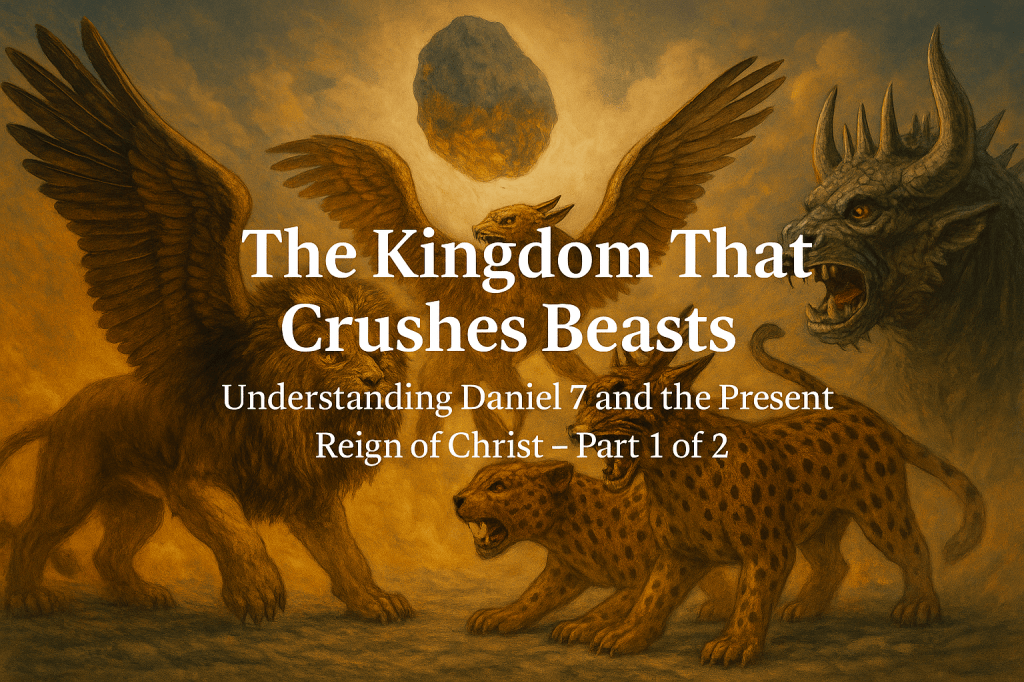
Understanding Daniel 7 and the Present Reign of Christ – Part 1 of 2
Introduction
This article is part one of a two-part series examining the powerful vision in Daniel 7—a chapter filled with prophetic imagery, rising empires, blasphemous beasts, and ultimate hope in the reign of Christ. Before diving into topics like the Antichrist, judgment, tribulation, and the millennial kingdom, we must first understand how God’s Kingdom operates and when it was established.
What you’ll read here lays the theological and prophetic foundation for interpreting Daniel rightly and living faithfully under the rule of Christ today.
Why Kingdom Theology Matters
Before we can rightly interpret the beasts, the horns, and the throne room visions of Daniel 7, we need to understand Kingdom theology. Knowing what the Kingdom of God is—and when it arrives—shapes how we understand everything from judgment and tribulation to hope and mission in the present.
Daniel’s Prophetic Shift
Daniel 7 begins with a shift in style and timeline. We’re no longer reading a chronological narrative, but a prophetic vision:
“In the first year of Belshazzar…”
This places the vision before Babylon’s fall, firmly in the 6th century BC. The events Daniel sees are future from his time, but not necessarily future from ours—a key interpretive insight.
Four Beasts, Four Empires
Daniel sees four symbolic beasts rising from the sea. An angel explains in verse 17:
“These four great beasts are four kings who shall arise out of the earth.”
This mirrors the four-part statue from Daniel 2—the sequence of earthly empires: Babylon, Medo-Persia, Greece, and Rome.
Babylon – The Lion with Wings
“The first was like a lion and had eagle’s wings… its wings were plucked off… it was made to stand like a man, and the mind of a man was given to it.” (Daniel 7:4)
This is Nebuchadnezzar’s Babylon. In Daniel 4, Nebuchadnezzar’s reason is stripped from him—like wings torn off—until he looks to heaven and is restored:
“My reason returned to me, and I blessed the Most High…” (Daniel 4:34)
Medo-Persia – The Bear with Ribs
The next beast is a bear raised up on one side with three ribs in its mouth. This reflects the dual nature of the Medo-Persian Empire and its three major conquests:
Babylon (539 B.C.) Lydia (546 B.C.) Egypt (525 B.C.)
“Your kingdom is divided and given to the Medes and the Persians.” (Daniel 5:28)
Some scholars suggest that the bear being raised on one side shows it mid-stride and ready to conquer. Others suggest the raised side represents Persia’s dominance over the Medes.
Greece – The Four-Headed Leopard
A leopard with four wings and four heads—symbolizing speed and eventual division.
“Another beast… like a leopard… it had four heads.”
Under Alexander the Great, Greece’s empire expanded at lightning speed. In just ten years, he conquered the Medo-Persian Empire and pushed east to the borders of India. After his death in 323 B.C., his empire was divided among four generals, aligning precisely with the four heads.
Daniel 8 later confirms that Greece follows Medo-Persia, offering further support for this interpretation.
Rome – The Dreadful Fourth Beast
“A fourth beast, terrifying and dreadful… It devoured and broke in pieces…”
This fierce beast parallels the iron legs of the statue in Daniel 2. Its unmatched power and brutality match ancient Rome—the final beast before the Kingdom is established.
It has iron teeth, ten horns, and a mysterious “little horn” that receives special attention later in the chapter. But even before exploring that, we notice a crucial statement in Daniel 2:44:
“In the days of those kings, the God of heaven will set up a kingdom that shall never be destroyed…”
This is a key moment. A divine Kingdom is coming—not alongside these earthly empires, but to replace them.
Next: The Son of Man and the Reign of Heaven
In the next article we’ll move from the chaos of beastly empires to the calm and majesty of heaven’s throne room. Daniel’s vision continues with the appearance of one like a Son of Man, the judgment of the final beast, and the establishment of an everlasting Kingdom.
Many have wrestled with the timing and nature of this Kingdom—whether it is still entirely future or already present in some way. While there are various perspectives within faithful Christian circles, there are compelling reasons within the text to see that much of this vision may already be fulfilled in the risen and reigning Christ.
In part two, we’ll consider these reasons carefully, seeking not just understanding, but deeper confidence in the Gospel and the unshakable hope that comes from knowing our King.

 Joel Littlefield
Leave a comment