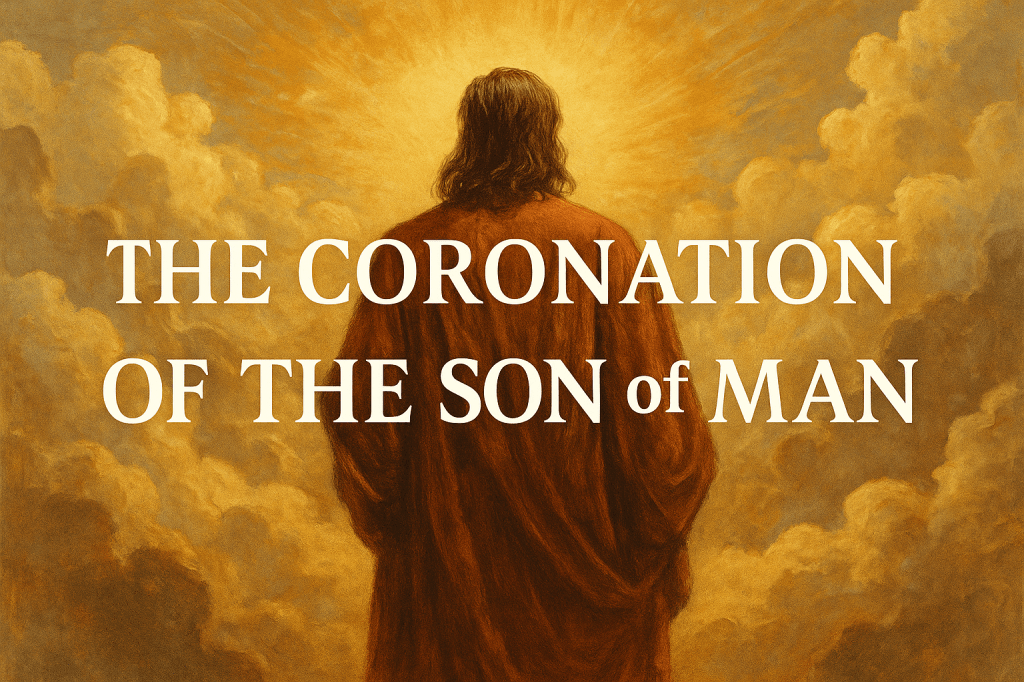
Understanding Daniel 7 and the Present Reign of Christ – Part 2 of 2
From Beasts to a Throne
In part one of this article, we explored Daniel’s vision of four beasts rising from the sea—symbolic representations of successive empires: Babylon, Medo-Persia, Greece, and Rome. Each kingdom grew more terrifying than the last. But Daniel’s vision doesn’t end with the chaos of earthly power. It transitions to the heavenly throne room, where a greater power is revealed.
The Ancient of Days Takes His Seat
“As I looked, thrones were placed, and the Ancient of Days took his seat; his clothing was white as snow, and the hair of his head like pure wool; his throne was fiery flames; its wheels were burning fire…”
(Daniel 7:9)
Here we see God the Father, radiant in holiness and majesty, seated in judgment. A river of fire flows from His throne. Thousands upon thousands stand before Him. The court is in session.
The final beast is judged. The arrogant little horn—representing blasphemous opposition to God—is stripped of its power and destroyed. Earthly empires are brought low before the sovereign judgment of heaven.
And then the focus shifts.
The Son of Man Enters
“I saw in the night visions, and behold, with the clouds of heaven there came one like a son of man, and he came to the Ancient of Days and was presented before him.”
(Daniel 7:13)
This verse is one of the most quoted messianic texts in the New Testament. Jesus used it to refer to Himself—most notably when standing before the high priest before His crucifixion:
“You will see the Son of Man seated at the right hand of Power, and coming with the clouds of heaven.”
(Mark 14:62)
Importantly, Daniel says the Son of Man comes to the Ancient of Days, not from Him. This is not about the second coming—it’s a heavenly scene. The Son of Man approaches the throne and is given dominion.
The Coronation of the King
“And to him was given dominion and glory and a kingdom, that all peoples, nations, and languages should serve him; his dominion is an everlasting dominion… and his kingdom one that shall not be destroyed.”
(Daniel 7:14)
This is royal coronation language. And it aligns perfectly with what Jesus said after His resurrection:
“All authority in heaven and on earth has been given to me.”
(Matthew 28:18)
Jesus was not waiting to be enthroned someday in the future. After His death, resurrection, and ascension, He was given the Kingdom. He now reigns from heaven, seated at the right hand of the Father, and His Kingdom is advancing.
Already and Not Yet
We live in the tension of what theologians call the already and not yet. The Kingdom of God has already been inaugurated, but it has not yet been fully consummated. Christ reigns now—but the final enemy, death, will be destroyed at His return.
In the meantime, we live under the rule of the King, bearing witness to His reign, and calling others to enter His Kingdom by repentance and faith.
The Nature of the Kingdom
Scripture describes the Kingdom in varied but complementary ways:
It is present: “The kingdom of God is in the midst of you.” (Luke 17:21) It is growing: Like a mustard seed that becomes a tree, or leaven that fills the dough (Matthew 13). It is future: We await a final, visible return where Christ judges the living and the dead.
The Kingdom is first and foremost God’s sovereign rule. It includes a people, a mission, and a future, but it is centered on the authority of Christ over all things.
Our Mission Under the Reign of Christ
As citizens of this Kingdom, we’ve been commissioned by the King Himself:
“Go therefore and make disciples of all nations… teaching them to observe all that I have commanded you.”
(Matthew 28:19–20)
This is how His rule is extended—not by sword or empire, but through the Gospel, through discipleship, through worship, and obedience. As we live under His reign and call others to do the same, the knowledge of the Lord spreads like a mountain that fills the whole earth (Daniel 2:35).
Hope in a Beastly World
Though the final beast is defeated in the vision, Daniel still lived under real oppression. So do we. The kingdoms of this world often still seem dominant. Evil rulers rise, and injustice is real. But Daniel 7 reminds us that Christ’s rule is ultimate.
He is not absent. He is enthroned. He is not waiting to be King. He already is.
Conclusion: Living in Light of the Throne
We don’t wait in fear. We wait as priests and citizens of a victorious Kingdom.
“To him who loves us and has freed us from our sins by his blood and made us a kingdom, priests to his God and Father, to him be glory and dominion forever and ever.”
(Revelation 1:5–6)
Christ has crushed the statue. The mountain is growing. The Son of Man reigns.
And one day—when the last enemy, death, is destroyed—we will see Him face to face. Until then, we walk in obedience, preach the Gospel, make disciples, and say with confidence:
Jesus is King. He reigns. And His Kingdom shall not be destroyed.

 Joel Littlefield
Leave a comment